
Rohde & Schwarz CBT32
| Attribut | Wert |
|---|---|
| Frequenzbereich | 30 MHz – 3 GHz |
| Bluetooth-Versionen | Bluetooth 1.x, 2.x, 3.x, 4.x (Classic & Low Energy) |
| Ausgangsleistung | -100 dBm bis +10 dBm |
| Anzahl der Testports | 32 Ports |
| Schnittstellen | USB, LAN (Ethernet), GPIB |
| Signalgenerator-Genauigkeit | ±1 dB Pegelgenauigkeit |
| Betriebstemperaturbereich | 0 °C bis +50 °C |
| Versorgungsspannung | 100 V – 240 V AC, 50/60 Hz |
| Abmessungen (B × H × T) | 483 mm × 88 mm × 450 mm (19 Zoll, 2 HE) |
| Gewicht | ca. 12 kg |
Rohde & Schwarz CBT32 Options:
- CBT32 - CBT-B41 - Dual-Channel Audio Generator and Analyzer (for R&S CBT32 only)
- CBT32 - CBT-B42 - Digital Audio Interface (S/P-DIF; R&S CBT-B41 required)
- CBT32 - CBT-K52 - A2DP Stereo Profile and SBC Codec (R&S CBT-B41 required)
- CBT32 - CBT-K54 - Handsfree and Headset Profiles
- CBT32 - CBT-K55 - Enhanced Data Rate (EDR)
- CBT32 - CBT-K57 - Bluetooth Low Energy Option (Low Energy Non-Signaling Measurements)
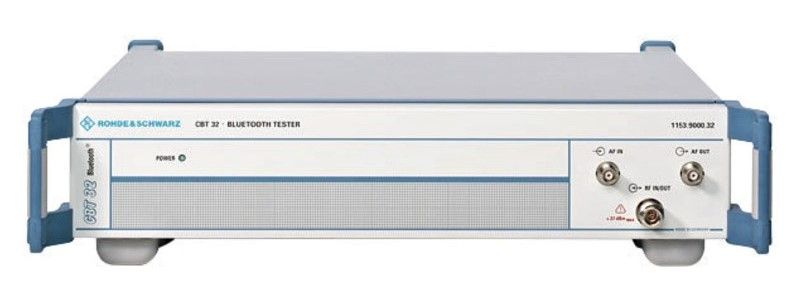
Rohde & Schwarz CBT32 Bluetooth Tester
The R&S CBT32 performs Bluetooth RF tests at very fast speed. In addition to power, modulation, frequency and BER tests, the Rohde & Schwarz CBT32 performs a variety of spectrum measurements on an active Bluetooth ® connection without requiring any extra spectrum analyzer test equipment. While conventional Bluetooth ® test equipment sequentially measure power, modulation, frequency accuracy, and frequency drift, the R&S CBT32 performs all these tests in a single cycle, which makes the CBT32 extremely quick in manufacturing evironments. For use in the laboratory, the R&S CBT32 offers traces for power, modulation and spectrum, which are output in real-time. An external display is required
Features of the R&S CBT32 include:
Power:
- Nominal power, peak power, leakage power
- Power control
- EDR: relative Power
Timing:
- Packet timing error
- EDR: guard time
Spectrum:
- 20 dB band-width, adjacent channel power (ACP), frequency range
- EDR: in-band spurious emissions (gated ACP)
Modulation:
- Average, maximum and minimum frequency deviation
- EDR: RMS DEVM, Peak DEVM, 99% DEVM
- EDR: differential phase encoding
- EDR: I/Q constellation diagram
- EDR: phase difference characteristic
Frequency:
- Frequency accuracy (ICFT), frequency drift, maximum drift rate
- EDR: carrier frequency stability ωi and ω0