Stanford Research
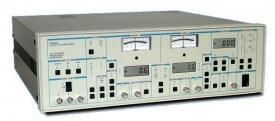
Stanford Research SR530
Lock-In Amplifier Dual Channel
0,5 Hz à 100 kHz Plage de fréquences
1 nV à 500 mV (plage complète) Sensibilité
jusqu'à 80 dB Réserve dynamique
0,01° (typique) Stabilité en phase
Différentielle ou single-ended, tension ou courant Type d'entrée
| Attribut | Valeur |
|---|---|
| Plage de fréquences | 0,5 Hz à 100 kHz |
| Sensibilité | 1 nV à 500 mV (plage complète) |
| Réserve dynamique | jusqu'à 80 dB |
| Stabilité en phase | 0,01° (typique) |
| Type d'entrée | Différentielle ou single-ended, tension ou courant |
| Bruit d'entrée en tension | 6 nV/√Hz à 1 kHz |
| Constante de temps du filtre | 1 ms à 100 s |
| Oscillateur de référence interne | 0,5 Hz à 100 kHz, résolution 4 chiffres |
| Interface de communication | IEEE-488 (GPIB) |
| Alimentation électrique | 100/120/220/240 V CA, 50/60 Hz |
Stanford Research SR530 Options:
- SR530 - Option 01 - GPIB interface for SR510/SR530
- SR530 - Option 02 - Internal oscillator
STANFORD RESEARCH SR530 Amplifier (call for availability)The Stanford Research SR530 Lock-In, Dual Channel Amplifier can measure AC signals as small as nanovolts in the presence of much larger noise levels. Features and Specifications of the Stanford Research SR530 Lock-In Amplifier include: Two stages of time constants Dual Channel Low-Noise Cur and Voltage Inputs Up to 80 dB dynamic reserve Tracking band-pass and line filters Internal reference oscillator Four ADC inputs, two DAC outputs Optional GPIB and RS-232 interfaces Frequency Range: 0.5 Hz to 100 kHz Input Impedance: 100 MO Input Noise: 7 nV/vHz