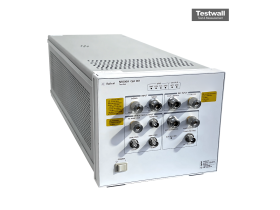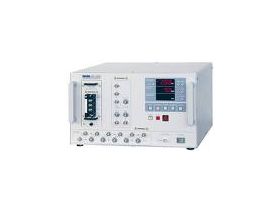
Berkeley Nucleonics 7300
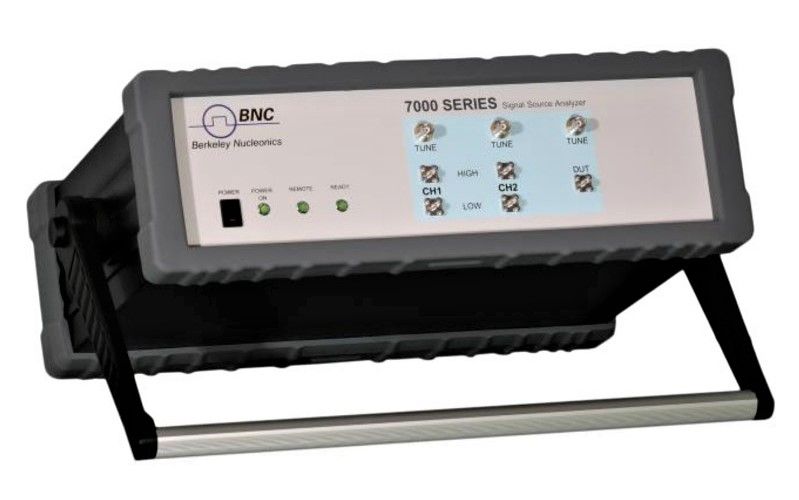
Berkeley Nucleonics 7300 Options:
- 7300 - GPIB - IEEE-488.2,1987 programming interface
- 7300 - LN - Ultra low close to carrier phase noise
- 7300 - P - Pulsed RF measurement capability
- 7300 - AM - Amplitude noise measurement capability
- 7300 - BURST - Pulse train measurements, masking of pulses
- 7300 - APN - Additive phase noise measurement
- 7300 - TRAN - Transient analysis
- 7300 - TSTAB - Time stability analysis
- 7300 - VCO - Voltage-controlled oscillator characterization
- 7300 - SPEC - Spectrum monitoring
| Model | 7300 |
|---|
BERKELEY NUCLEONICS 7300 Signal Source Analyzer
The Berkeley Nucleonics 7300 is an integrated solution that offers an indispensable set of measurement functions for evaluating signal sources ranging from VHF to microwave frequencies such as crystal oscillators, PLL synthesizers, clocks, phase-locked or free-running VCOs, DROs, SAW or YIG oscillators, and others. The flexible instrument comprises a two-channel cross-correlation system with two internal tunable references sources and also allows measurements with externally fed references. It is a compact and powerful instrument available with LAN (VXI-11), USBTMC, or with GPIB (optionally) interfaces. Platform independent intuitive graphical user interface (GUI), API library, and powerful SCPI command language set are available. The Berkeley Nucleonics 7300 has a frequency range from 1 MHz to 26 GHz.
Features of the BERKELEY NUCLEONICS 7300 Signal Source Analyzer Include:
- Absolute and residual phase noise measurements
- Amplitude noise measurements
- Pulsed absolute and residual phase noise measurements
- Two channel 100 MHz FFT analyzer
- Transient measurements (frequency, phase, amplitude versus time)
- Spectrum analysis
- Frequency counter function / power meter