Rigol
Rigol DS2202A-S
High quality 2 channel DSO with 200 MHz bandwidth + 2 channel waveform generator with 25 MHz bandwidth, 2 GSa/s and 14 Mpts memory depth.
200 MHz Ancho de banda
2 canales analógicos Número de canales
2 GSa/s Frecuencia de muestreo
56 Mpts (estándar) Profundidad de memoria
8 pulgadas TFT LCD (800 x 480 píxeles) Tamaño de pantalla
| Atributo | Valor |
|---|---|
| Ancho de banda | 200 MHz |
| Número de canales | 2 canales analógicos |
| Frecuencia de muestreo | 2 GSa/s |
| Profundidad de memoria | 56 Mpts (estándar) |
| Tamaño de pantalla | 8 pulgadas TFT LCD (800 x 480 píxeles) |
| Tasa de captura de formas de onda | hasta 50.000 formas de onda por segundo |
| Resolución vertical | 8 bits |
| Rango de escala de tiempo | 1 ns/div a 1 ks/div |
| Generador de señal integrado (opción S) | Generador de forma de onda arbitraria de 25 MHz incluido |
| Interfaz de conectividad | USB Host, USB Device, LAN (LXI), Aux (salida de disparo) |
| Model | DS2202A-S |
|---|
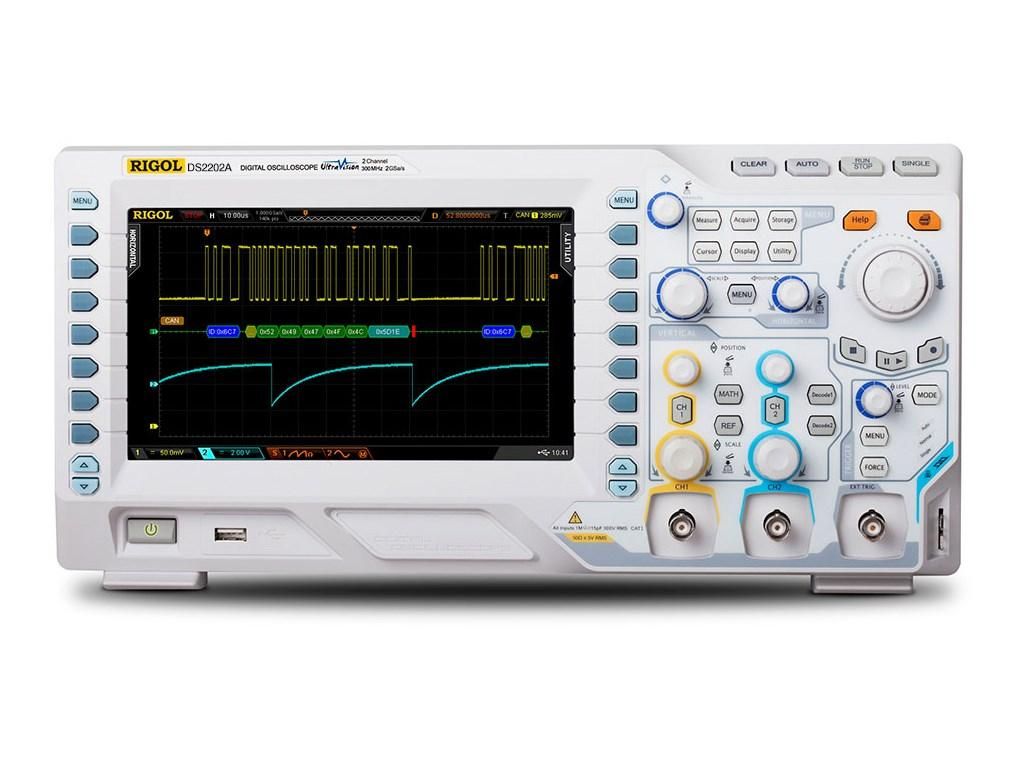
The Rigol DS2202A-S is a very high quality two channel digital storage oscilloscope. It features a real-time sample rate of up to 2 GSa/s, a bandwidth of 200 MHz and an additional built-in 2CH arbitrary waveform generator for frequencies up to 25 MHz.
The Rigol oscilloscopes are equipped with well designed and easy to use controls offering comprehensive ease-of-use functions for all measuring tasks. The menu navigation is intuitive and available in several languages.
This high performance standard not only ensures capturing real-time instantaneous signals, but also observes details of repeated signals. The DS2072A has a refresh rate of up to 50.000 wfms/s, enabling users to capture instantaneous signals, as well as abnormal signals more quickly. It also helps to enhance the waveform capturing ability and to expedite a circuit debug course. The quality of the Rigol oscilloscopes is comparable to Agilent and Tektronix oscilloscopes.
The particularly large TFT color displays are very easy to read. Thanks to an intelligent system for displaying or masking information, the largest possible area is always available for displaying signals. The signal curves, the FFT display, and other functions can be shown simultaneously on the display.