
Tektronix
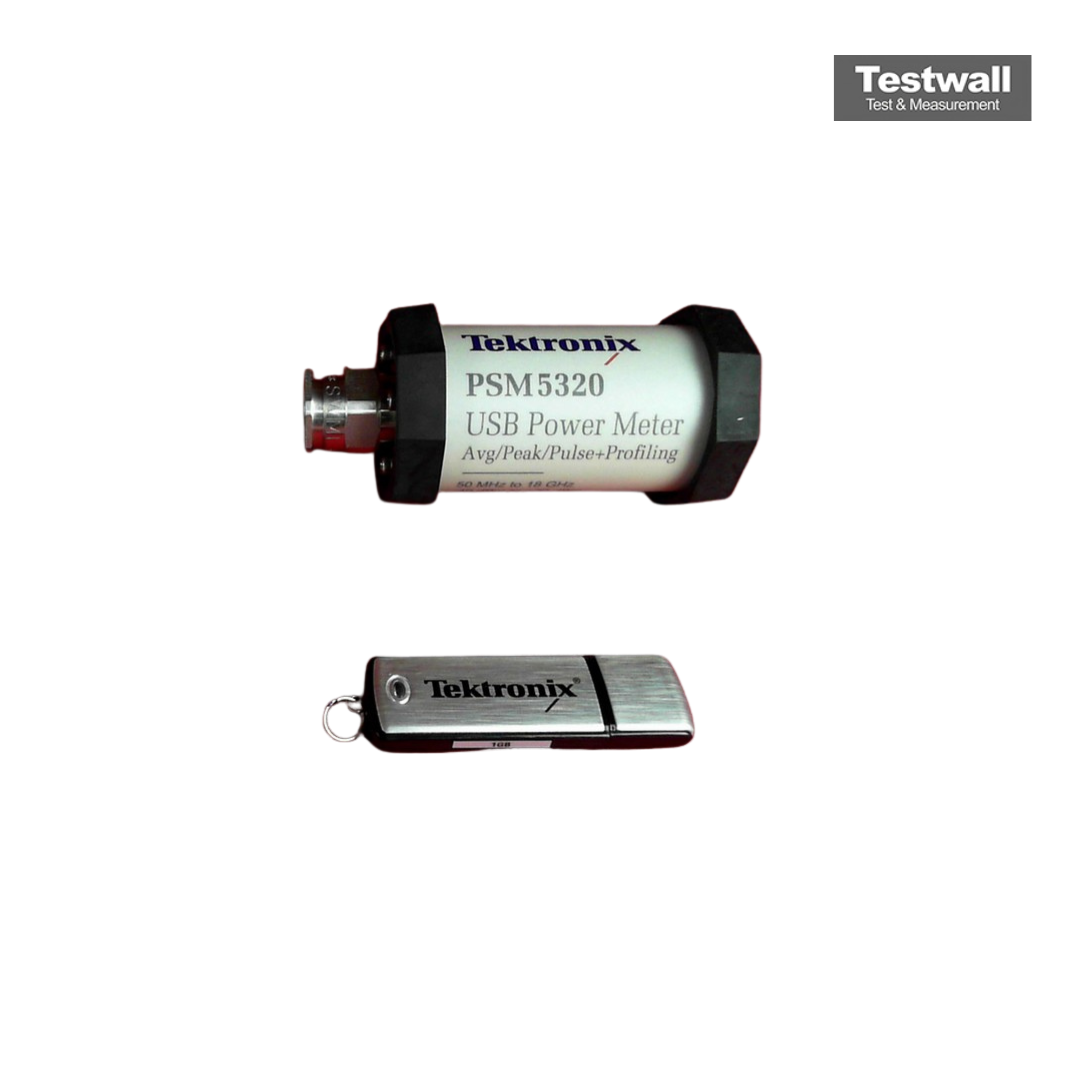
Tektronix PSM5320
USB Power Sensor, 50 MHz - 18.6 GHz, -40 dBm to +20 dBm, N-Type
10 MHz à 18 GHz Plage de fréquences
-35 dBm à +20 dBm Plage de puissance mesurable
±0,5 dB Précision de mesure
Type N (50 Ω) Connecteur d'entrée RF
Inférieur à 10 ms Temps de réponse
| Attribut | Valeur |
|---|---|
| Plage de fréquences | 10 MHz à 18 GHz |
| Plage de puissance mesurable | -35 dBm à +20 dBm |
| Précision de mesure | ±0,5 dB |
| Connecteur d'entrée RF | Type N (50 Ω) |
| Temps de réponse | Inférieur à 10 ms |
| Interface de communication | USB, compatible SCPI |
| Alimentation | Via port USB (bus alimenté) |
| Température de fonctionnement | 0 °C à +55 °C |
| Dimensions | 25,4 mm × 25,4 mm × 101,6 mm |
| Poids | Environ 90 g |
Tektronix PSM5320 Options:
- PSM5320 - C3 - Calibration Service 3 Years
- PSM5320 - C5 - Calibration Service 5 Years
- PSM5320 - R5 - Repair Service 5 Years
Tektronix Power Sensor
Tektronix PSM5320 USB Power Sensor, 50 MHz - 18.6 GHz, -40 dBmt +20 dBm, N-Type
The Tektronix PSM3000, PSM4000, and PSM5000 Series are compact power sensors/meters that deliver fast, accurate RF and microwave power measurements. A broad range of CW and pulse modulation measurements are available, depending on the series you choose. Each meter comes with Windows Power Meter application software for controlling the meter, displaying readings, and recording data. The combination of the sensor/meter and PC provides a complete solution, eliminating the need for a separate, dedicated meter mainframe.
Features and Specifications of the Tektronix PSM5320 includes:
- 8 GHz, 18 GHz, 20 GHz, and 26.5 GHz Models
- Models Available with N and 3.5 mm Connectors
- Dynamic Range as Low as €“60 dBm and as High as +20 dBm
- Uncertainty as Low as 2.6%
- Reading Rates up to 2000 Readings/s
Features
- Meters are Calibrated over Full Temperature Range €“ No zero or cal needed before making measurements, saving time and avoiding poor-quality data
- Average Power, Duty Cycle Corrected Pulse Power, and Measurement Logging on All Models
- Included Applications run under Microsoft Windows
- Power Meter Application
- High-speed Logging Application
- LabVIEW Drivers and Programming Examples for Most Common Windows Programming Environments are Available for Automated System Support
- Max Hold and Relative Measurement Modes
- Offset, Frequency Response, and 75 ? Minimum Loss Pad Correction
- Flexible Averaging Modes for Quick, Stable Measurements
- TTL Trigger Input and Output allow Synchronization with External Instruments
- Pass/Fail Limit Mode
- Compact Size
- The PSM3000 Series offers True Average Power Measurements that Give Accurate Results Regardless of Signal Shape or Modulation
- The PSM4000 and PSM5000 Series offer:
- Pulse Power, Duty Cycle, Peak Power, and Crest Factor Measurements
- Measure Peak, Average and Minimum Power on Bursts with Adjustable Offset and Duration
- The PSM5000 Series includes a Pulse Profiling Application for Making Measurements on Repetitive, Pulsed Signals
- Builds and Displays a Trace of the Pulse Envelope
- Full-trace and Gated Measurements including Pulse, Peak and Average Power, Overshoot, Crest Factor, Rise and Fall Time, Pulse Width, Pulse Repetition Frequency, Duty Cycle
- Statistical Measurements on the Trace Data, such as Complementary Cumulative Distribution Function (CCDF), and Probability Density Function (PDF)