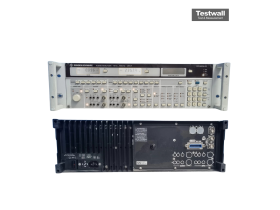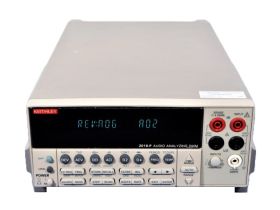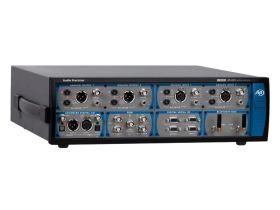

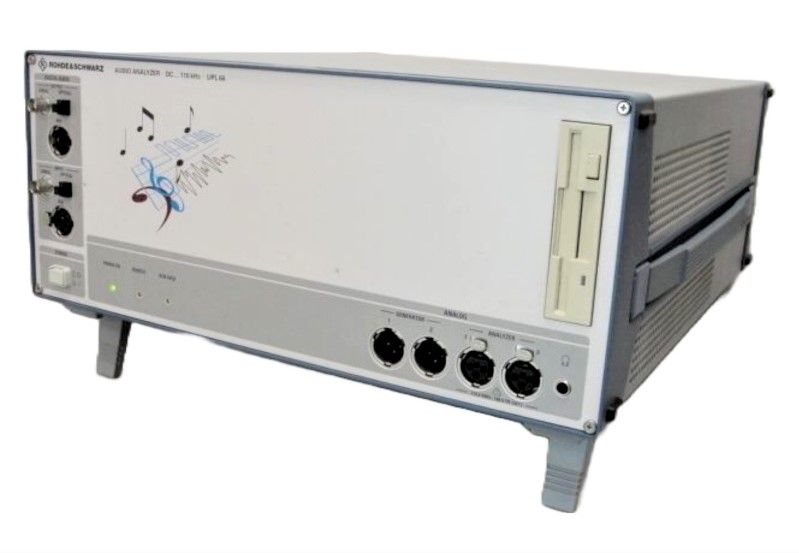
Rohde & Schwarz UPL66
| Atributo | Valor |
|---|---|
| Rango de frecuencia | 10 Hz – 110 kHz |
| Rango de nivel de entrada | 100 µV – 300 V (valor RMS) |
| Distorsión armónica total (THD+N) | Inferior a -100 dB |
| Impedancia de entrada | 200 kΩ / 20 pF (balanceada o no balanceada) |
| Generador de señal integrado | Sí, generador de audio de doble canal con frecuencia ajustable |
| Canales de medición | 2 canales simultáneos (estéreo) |
| Interfaz de comunicación | IEEE 488 (GPIB) e interfaz serie RS-232 |
| Tipos de medición | Nivel, frecuencia, fase, THD, THD+N, relación señal/ruido, diafonía y espectro FFT |
| Pantalla | Pantalla gráfica integrada para visualización de resultados y espectros |
| Alimentación eléctrica | 100 V – 240 V CA, 50/60 Hz |
Rohde & Schwarz UPL66 Options:
- UPL66 - R&S UPL-B1 - Low Distortion Generator
- UPL66 - R&S UPL-B2 - Digital Audio I/O 48 kHz
- UPL66 - R&S UPL-B29 - Digital Audio I/O 96 kHz
- UPL66 - R&S UPL-B21 - Digital Audio Protocol
- UPL66 - R&S UPL-B22 - Jitter and Interface Test
- UPL66 - R&S UPL-B23 - Coded Audio Signal Generation
- UPL66 - R&S UPL-B4 - Remote Control
- UPL66 - R&S UPL-B5 - Audio Monitor
- UPL66 - R&S UPL-B6 - Extended Analysis Functions
- UPL66 - R&S UPL-B7 - Hearing Aids Test Accessories
- UPL66 - R&S UPL-B8 - Mobile Phone Test Set
- UPL66 - R&S UPL-B9 - 3G Mobile Phone Tests
- UPL66 - R&S UPL-B10 - Universal Sequence Controller
- UPL66 - R&S UPL-B11 - LAN Interface for R&S UPL06/66
- UPL66 - R&S UPL-B33 - Line Measurement to ITU-T O.33
- UPL66 - R&S UPL-Z1 - XLR/BNC Adapter Set
- UPL66 - R&S UPL-U3 - 150 Ω Modification
| Model | UPL66 |
|---|
The R&S UPL66 (and UPL06) Audio Analyzer performs practically all types of analog measurements, from frequency response to externally controlled sweeps with reference traces, determination of 3rd-order difference frequency distortion, spectral display of demodulated wow and flutter signals, etc. In contrast to many other analyzers the UPL66 is capable of performing real dual channel measurements in the audio frequency range, i.e., there is no need for switchover between two inputs.
The Rohde & Schwarz UPL66 and UPL06 models feature excellent specifications: analgo sinewave generation with harmonics of typical -115 dB, spectrum displays with a noise floor below -140 dB for analog and -160 dB for digital interfaces, FFT with a maximum frequency resolution of 0.05 Hz, etc.
The R&S UPL66 Audio Analyzer offers a large selection of functions for both analog and digital interfaces (with option B2):
- Level or S/N with rms, peak or quasi-peak weighting
- Selective level: The center frequency of the bandpass filter can be swept or coupled to the generator frequency, to the frequences of a multitone signal
- SINAD or (THD+N): The sum of all harmonics and noise is measured
- Total harmonic distortion (THD): Single harmonics, all the harmonics or any combination can be measured
- Modulation distortion to DIN/IEC 2683: 2nd and 3rd Order intermodulation is measured
- Intermodulation using the difference tone method: 2nd and 3rd Order intermodulation is measured
- Wow and flutter to DIN/IEC, NAB, JIS or the 2-sigma method where the demodulated signal spectrum is also displayed
- Polarity test for checking signal paths for reversed polarity
- Crosstalk
- DC Voltage
- Frequency, phase and group delay
The UPL66 and UPL06 have the exact same technical specifications with the difference being that the UPL66 does not have a front panel display or keyboard as does the UPL66. The UPL66 is controlled externally.
With the addition of option B2, the UPL66 can supply a wide variety of digital test signals:
- Sine Waves for level and harmonic distortion measurements. The signal can be applied to an equalizer with user-selectable nominal frequency response, e.g., for compensating the frequency response of the test assembly.
- Two-tone signal for modulation distortion analysis. Various amplitude ratios can be selected and the frequencies are continuously adjustable.
- Difference tone signal for intermodulation measurements with continuous setting of the center frequency and frequency difference.
- Multitone signal comprising up to 17 sine waves of any frequency and with the same or diffe levels
- Special mutltitone signal comprising up to 7400 frequencies with selectable amplitude distribution. The frequency spacing can be linked to the resolution used for the Fast Fourier Transform, enabling rapid and precise single-shot measurements of the frequency response of a DUT
- Sine burst signal with adjustable interval and on-time and programmable low level, e.g. for testing AGCs
- Square sine burst also with adjustable interval and on-time, e.g., for testing rms rectifier circuits
- Noise with a variety of probability distributions, e.g., for acoustic measurements
- Arbitrary waveforms for generating any voltage curve of up to 16k points
For continuous variation of the test signals the UPL66 offers amplitude and frequency sweeps, and for sine and sine squared bursts, additional sweeps of the interval and the on-time.
The UPL66 is also capable of spectrum analysis. The number of samples for FFT can be selected between 256 and 16k binary steps. FFT Zoom is a special feature is digitaly preprocessed to increase the frequency resolution by a factor of 2 to 128 times normal over a selectable range. In this way, a maximum resolution of 0.05 Hz is attained.
Any number of software filters can be defined. Common filters such as weighting, are provided as standard. Further filters can be easily programmed in a few seconds by entering the type (lowpass, highpass, bandpass, bandstop, notch, third octave, or octave), frequency and attenuation.
The R&S UPL66 was designed for audio measurement of sound cards, multimedia cards, R&D of hearing aids, and production test of audio equipment.
Features of the UPL66 include:
- All interface types: Analog, Digital and Combined
- Real Dual Channel measurements
- Maximum Dynamic Range
- FFT Analysis
- Jitter Analysis
- Interface Tester
- Freely Programmable Filters
- Versatile Functions
- Automatic Test Sequences
The UPL66 audio analyzer offer increased voltage input range, low-distortion generators, and jitter susceptibility to meet the revised AES17 standard.